Aerial Applicators
The State of North Dakota has provisions for becoming an Aerial Applicator - you can find them here. There is time and preparation involved in collecting documentation and working with different agencies. If you are aerial applicating in the state at any time, even private land, please see the requirements listed below before spraying in North Dakota.
Prevent penalties. | Be licensed. | We’re here to help.
Licensure is a requirement by the North Dakota Aeronautics Commission (NDAC) before you spray as per the North Dakota Administrative Code 6-02-02. (This is different from, and in addition to, NDSU Extension Service's Pesticide Applicator Certificate Number, and from your Part 137 or Part 107.) See the reference sheets provided below to assist with this process. You must have your approved NDAC aerial applicator license in hand prior to spraying. This license must identify every pilot spraying for your company and list every registered aircraft (which includes each drone, if any). This applies to in and out of state operators, pilots, and aircraft. (Qualified pilots, and aircraft, can easily be added throughout the year as needed.) This is an annual process as all licenses and registrations in the state expire December 31st of each year.
Do you have questions about reciprocity? Contact NDSU Extension for a packet.
After you are properly licensed with our office for the year, your name will appear here.
The 2027 Tri-State Aerial Applicators Convention will be held February 17-18 at the Delta Hotel in Fargo, North Dakota. If your North Dakota Pesticide Applicator Certification Number will expire,
PAASS will take place from 10:30 am to 3:30 pm on February 17th during the convention. Pilots will be required to register and pay for PAASS on the
Tri-State website once it is active. Contact
Alexis, Executive Director (NDAAA) with Tri-State or PAASS registration questions!
NDAC'S ROLE:
We are the regulatory agency for aeronautics and we verify the following from the various agencies:
-
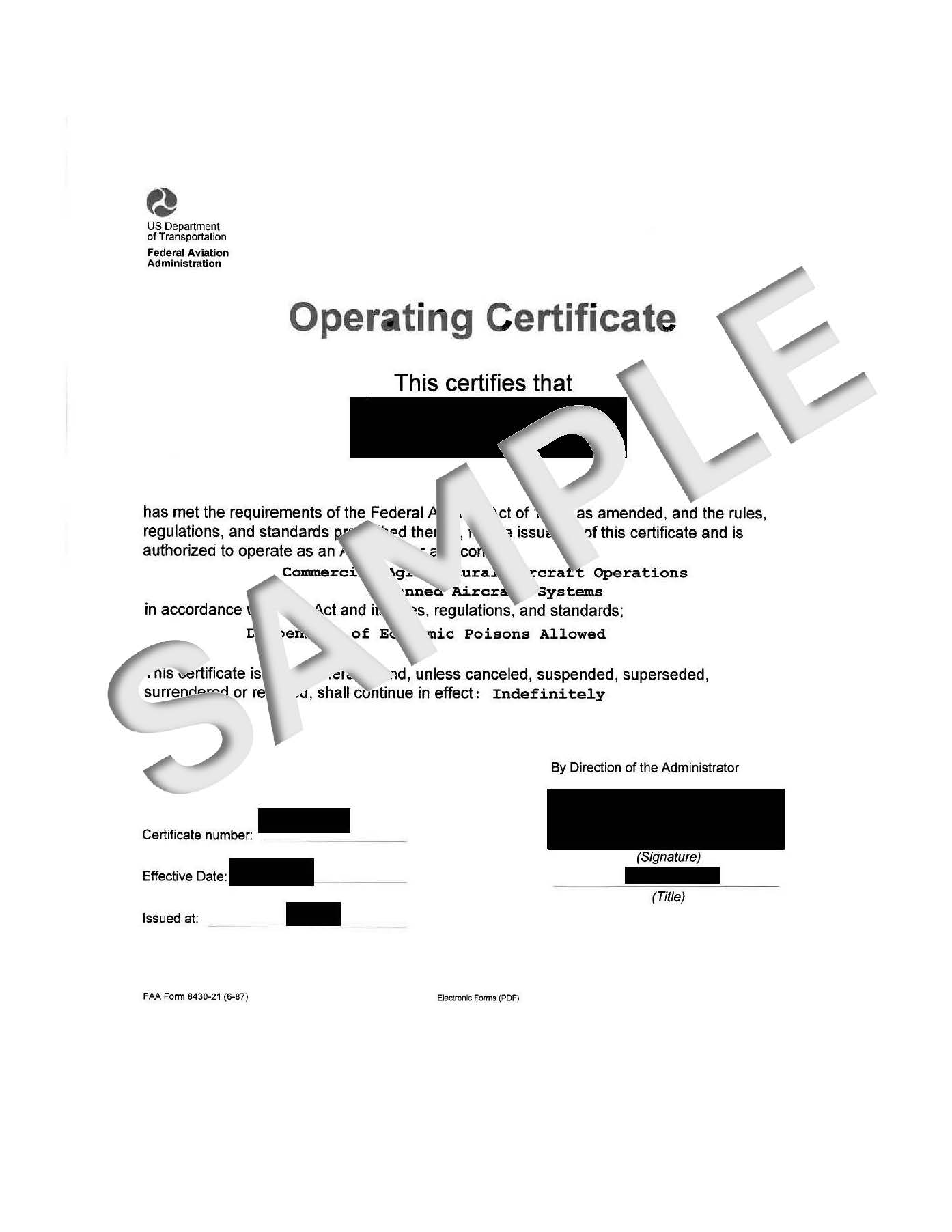
Operation has Part 137 operating certificate from the FAA (for UAS, per the FAA, operators must hold both a valid exemption and an AAOC [Agricultural Aircraft Operator Certificate] in order to conduct operations);
-
All pilots have Part 107 from the FAA and are known to our office;
-
All pilots have current ND Pesticide Applicator Certification Number with the Air/Ground Core component;
-
A chief pilot is identified and qualified, and either the chief pilot or the owner/operator have attended an annual safety training (review the Policy Memorandum regarding the NDAC safety meeting change for 2027);
-
All aircraft are registered with the FAA and our office, receiving a NDAC registration number.
MANNED Aerial Applicator Application Options: ($200 application fee and all aircraft must be registered)
-
Commercial Aerial Applicators License: Complete SFN 7546
-
Private Manned Aerial Applicators License: Complete SFN 2360 (Pilot's own land or land farmed by the pilot; not for hire).
-
UNMANNED Aerial Applicator Application: ($200 application fee and all drones must be registered) Note: If you are already a licensed manned operator and have paid that annual fee, the unmanned fee is waived, but you must complete the application.
Spring 2022 was the first opportunity for operators to apply for an aerial applicator license specifically for unmanned aircraft. The administrative code was updated and now includes requirements and safety standards for unmanned aircraft operators to provide aerial application in North Dakota. Before you can even begin to apply chemicals with a drone in North Dakota, even on your own farm, the owner/operator needs an 'Agricultural Aircraft Operator Certificate' from the FAA (Part 137), each pilot needs a North Dakota Pesticide Certificate (NDSU) and a Remote Pilot Certificate from the FAA (Part 107). Finally, the owner/operator must be approved for the Unmanned Aerial Applicator License from the North Dakota Aeronautics Commission. It's alot, but this checklist can help.
-
Complete: SFN 62124 (There is no difference between commercial and private unmanned aerial applicators.)
-
Register your spray drone here. (Aerial applicating drones do not need to be registered until you apply for the aerial applicator license, but before you spray.)
-
-
If you have questions about the status of your UAS Part 137, you must email UAS137Certificates@faa.gov to find out the status of your application.
-
REFERENCES:
-
-
-
-
*Game Board (see the steps you'll need to take to become an Unmanned Aerial Applicator)
-
-
-
-
-
-
-
-
-
-
FROM THE DIRECTOR (06/29/2026): Unmanned Aerial Application Operators
|
The North Dakota Aeronautics Commission has recently received some concerned inquiries regarding unmanned aerial application operations occurring in the close vicinity of private airstrips without prior coordination with the airstrip owner or operator. While communication may not be required in all circumstances, these inquiries serve as an important reminder of the value of proactive coordination and situational awareness when conducting unmanned aerial application operations in very close proximity of nearby airports and airstrips.
As aerial application operations utilizing unmanned aircraft continue to grow across North Dakota, the North Dakota Aeronautics Commission would like to remind all operators of the importance of maintaining awareness of nearby aviation activities and coordinating with both public and private airports when operating in their vicinity. This recommendation is intended to promote safety and cooperation among all segments of North Dakota's agricultural aviation community.
Prior to conducting UAS operations, operators should review the locations of nearby public-use and private-use airports. The FAA's Airport Data and Information Portal (ADIP) provides a useful resource for identifying these facilities and includes an interactive map displaying both public and private airports throughout North Dakota. To identify the airports within North Dakota, simply select "North Dakota" under the state search criteria and execute the search. Results can then be downloaded or displayed on an interactive map. The ADIP database can be accessed at: https://adip.faa.gov/agis/public/#/airportSearch/advanced
If operations are planned near a public-use or private-use airport or airstrip, the North Dakota Aeronautics Commission strongly encourages operators to proactively communicate with the airport manager, airport owner, or other appropriate representative prior to commencing operations. While FAA regulations may not require direct notification in all circumstances, early coordination can help identify scheduled flight activity, agricultural aviation operations, flight training, maintenance flights, aerobatic operations, and other aviation activities occurring in the area. Communication between operators can help reduce potential conflicts and improve situational awareness for all airspace users.
Also as a reminder, all unmanned aerial application operations must be conducted in accordance with applicable FAA regulations, exemptions, waivers, and operating authorizations. Operators should ensure they comply with all conditions and limitations applicable to their specific operation, including visual line of sight requirements where applicable. Operators are also reminded to remain vigilant for other aircraft, monitor the operating environment for potential hazards, and always yield the right-of-way to manned aircraft.
We appreciate your commitment to operating safely and professionally and encourage continued coordination with fellow members of North Dakota's aviation community. Your efforts help support the safe integration of unmanned aircraft into our state's airspace system.
|
CHIEF PILOT:
Chief Pilot means an individual, who meets the qualifications of Chapter 6-02-02-04, that operates an aircraft used for aerial application who is identified on the aerial applicator's license and is responsible for the supervision of other pilots listed on an aerial applicator's license.
Chief Pilot qualifications MANNED:
*All operators or contractors employing one or more commercial pilots for the purpose of conducting aerial application by aircraft in this state shall employ at least one chief pilot who shall have the qualifications set forth in this section:
*A chief pilot must produce evidence of a commercial federal aviation administration license with a minimum of seven hundred fifty flight hours as pilot in command, of which a minimum of two hundred fifty flight hours as pilot in command must be in the class of aircraft in which the sprayer or duster equipment will be installed and used for aerial application. In addition, the chief pilot must have at least two years apprentice commercial aerial application experience as pilot in command and has accumulated at least two hundred hours total aerial application flying time as an employee, supervised by a North Dakota chief pilot who holds a federal aviation administration part 137 certificate, who may recommend the applicant and certify the applicant's qualifications for the operational level sought, or certified to by an affidavit of the applicant, subject to investigation by the aeronautics commission, which may approve or deny the application.
*Chief pilot based within the state of North Dakota required. It is the responsibility of the chief pilot to determine the amount of supervision a pilot requires. The chief pilot must be familiar with the area in which the supervised pilot or pilots are flying and be able to contact each pilot daily as needed. Pilots with less than two years' experience and less than two hundred fifty hours of actual aerial application must be under the direct, personal supervision of a chief pilot and must be based out of the same airport as the airport in which the chief pilot is operating. The chief pilot or the chief pilot's designated representative of every aerial application operation licensed by the aeronautics commission must be located within North Dakota during the time of actual aerial application operations and the chief pilot shall be responsible for the actions of all pilots under the chief pilot's supervision.
Chief Pilot qualifications UNMANNED:
*All operators or contractors employing one or more unmanned aircraft pilots for the purpose of conducting aerial application by an unmanned aircraft in this state shall employ at least one chief pilot. A chief pilot must meet the pilot qualifications of this subsection.
*It is the responsibility of the chief pilot to determine the amount of supervision a pilot requires and ensure each pilot is able to contact the chief pilot during aerial application operations.
*A pilot who is identified on the aerial applicator's license must hold a federal aviation administration remote pilot certificate and ND Pesticide Applicator Certification. Before conducting solo flights, pilots must have attended an approved training program or have received at least ten hours of direct ground-supervised solo flight at operational loads while conducting aerial application. Supervision must be provided by a pilot who has conducted a minimum of twenty-five hours of solo flight at operational loads while conducting aerial application. The operator shall document and maintain written records verifying the pilot has fulfilled the flight requirements.
AIRWORTHINESS CERTIFICATE REQUIRED:
All aircraft licensed for aerial application in North Dakota shall have a current and valid Federal Aviation Administration airworthiness certificate.
REVOCATION OF AERIAL APPLICATOR LICENSE:
The Director of the North Dakota Aeronautics Commission reserves the right to revoke or refuse to issue an aerial applicator's license for just cause, or for violation of any rule, regulation, procedure or standard after a hearing has been held. On the basis of proper cause shown, the director of this Aeronautics Commission may also suspend a license or refuse to issue a license until such time as a hearing has been held.
PENALTY FOR VIOLATION OF THE RULES AND REGULATIONS:
Attention is drawn to ND Century Code section 2-05-18, which relates to the licensing of aerial applicators of agricultural chemicals and provides that any person convicted of violation of any provision of that section or rules or regulation promulgated under the authority of that section shall be guilty of a class B misdemeanor.
AERIAL APPLICATOR ALERT MAPS:
To view the North Dakota Aerial Applicator alert map to learn more about the locations of met towers and sensitive areas, visit the Maps page. The North Dakota Department of Agriculture also provides a great GIS mapping resouce for sensitive areas which can be found on their website.